
How to start a task when your brain won't
Four ways to get going on a task you keep putting off, from shrinking the first step to borrowing a body double, each with a source.
Say it's 2pm. The task has been on your list since Monday. You've opened the document twice, checked the weather once, and reorganized a drawer you hadn't thought about in a year. You want to do the task. You just can't seem to begin.
If that sounds familiar, the problem usually isn't the task itself. It's the start. And the start is something you can make smaller, plan ahead, share with someone, or sweeten.
Why starting is the hard part
The National Institute of Mental Health lists procrastination, disorganization, and trouble with time management and planning among the ways ADHD can show up in adult life. It also mentions trouble focusing on a large task and finishing projects. If your brain works this way, the tasks that are big, vague, or boring tend to be the hardest ones to begin.
Big and vague are the two you can change. A task like "do taxes" or "clean the apartment" has no obvious first move, so your brain looks for one, doesn't find it, and wanders off to the drawer.
Make the first step almost too small
The first step should be something you could do in about two minutes without deciding anything. Not "write the report." Open the file and type the title.
A good first step is physical and specific. You can picture your hands doing it. "Find last year's W-2" works. "Start taxes" doesn't.
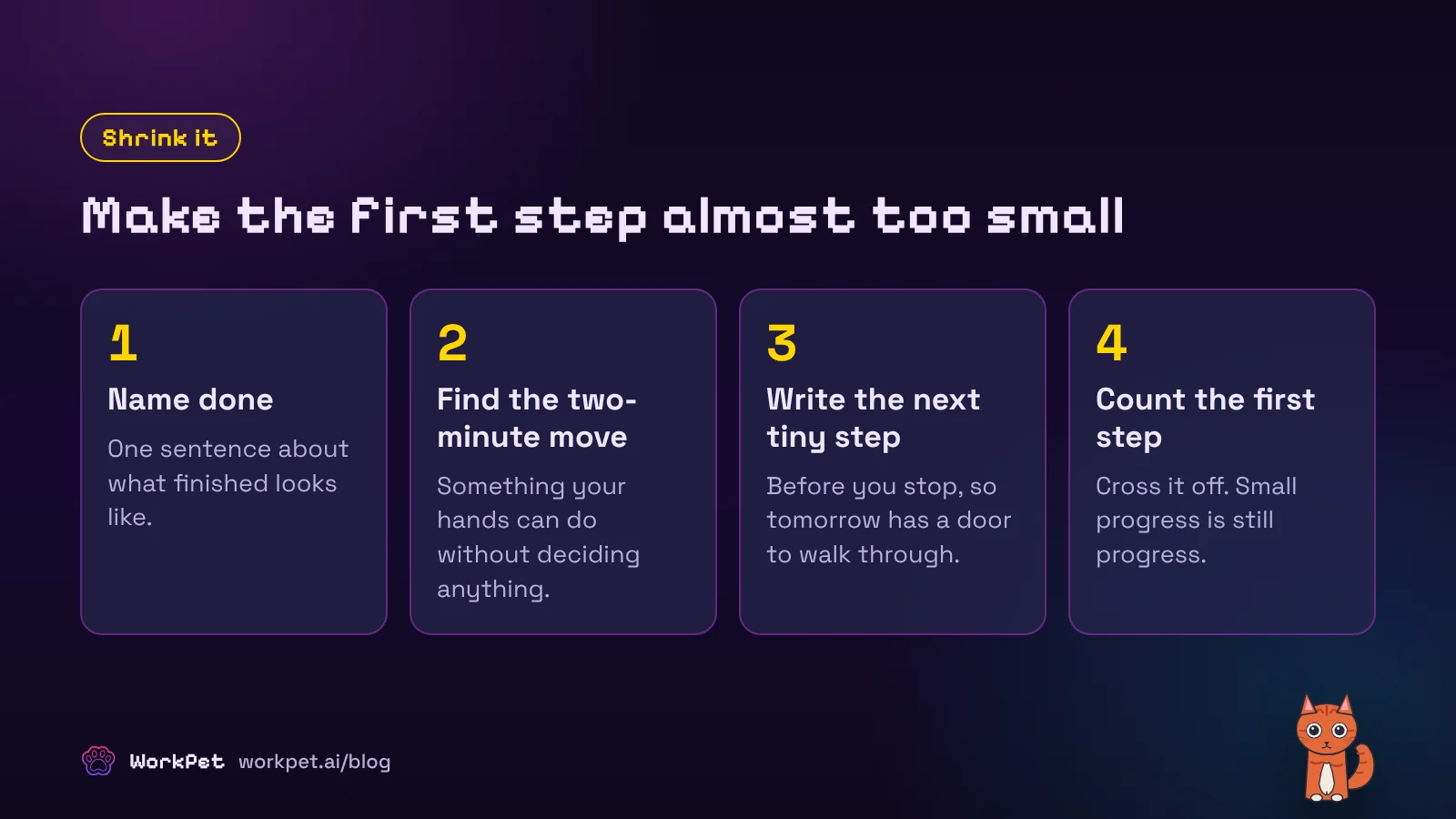
Once the first step is done, the second one usually shows itself. If it doesn't, write the next tiny step down before you stop. Future you will thank present you for leaving a note on the door.
It can feel silly to put "open the laptop" on a to-do list. Do it anyway. Crossing off something small is still crossing something off, and seeing that progress can make the next step easier to face.
Decide when and where, ahead of time
Psychologists call this an implementation intention. It's a plan in the form "if this happens, then I'll do that." For example, "When I sit down after lunch, I'll open the budget spreadsheet."
It sounds almost too simple. But Peter Gollwitzer and Paschal Sheeran pulled together 94 independent tests of these if-then plans in a 2006 meta-analysis, and found a medium-to-large effect on reaching goals (d = .65). They also reported that the plans helped people get started on goals in the first place, which is exactly the part that keeps stalling.
The trick is to tie the task to something that already happens every day.
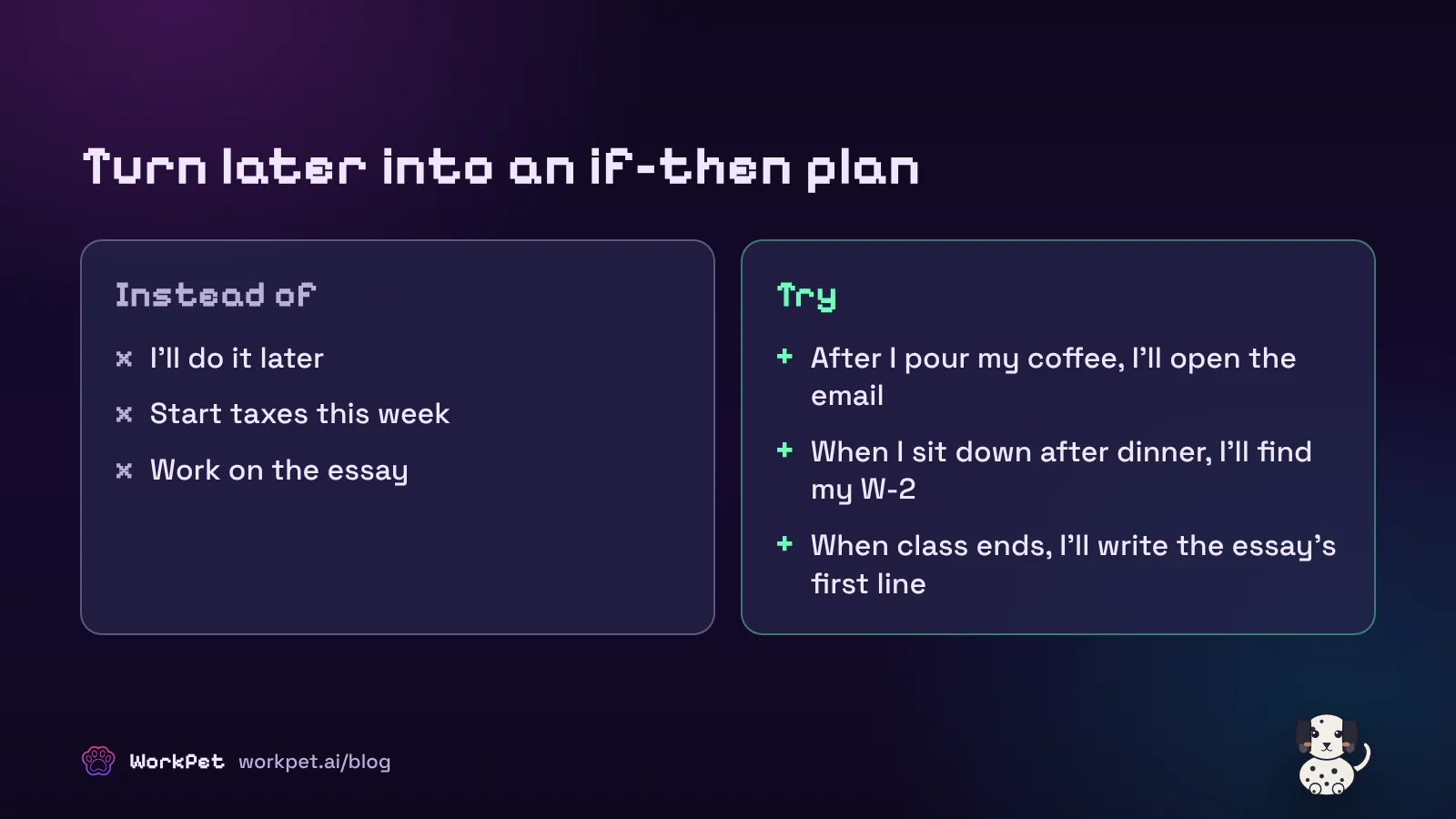
Pick one task and write one if-then plan for it. One is enough to test whether it works for you.
Borrow someone else's focus
Body doubling means working on your own task while someone else works nearby. They don't help you. They're just there. CHADD describes a body double as a friend or partner who works at the same time, in the same room or over a video call, and lists chores, homework, bills, and taxes among the things people use it for.
The other person can be a roommate folding laundry, a friend on a muted video call, or a stranger in a coworking session. Some people find that the quiet company makes it easier to start and harder to drift off.
CHADD is also honest that there hasn't been much research on body doubling yet, and that it doesn't work for everyone. If your body double turns every session into a chat, try someone quieter, or set a rule that you talk only during breaks.
Pair it with something you like
In a 2014 study, Katherine Milkman, Julia Minson, and Kevin Volpp gave gym members audiobooks they could only listen to while working out. They called it temptation bundling. Early on, people who could only get the audiobooks at the gym went 51% more often than the control group. People who were simply encouraged to save the books for the gym went 29% more often.
The effect faded over time, especially after Thanksgiving break. That's useful to know. A reward that works this month might need swapping out next month, and that's normal.
You can bundle almost anything. Save a favorite podcast for doing the dishes. Make the good coffee only on the days you answer email. Light the nice candle when you open the tax folder.
When it still won't start
Some days none of this works. That's not a sign that you failed. It's a sign the task is still too big, or that you're out of energy for today.
Make the step smaller again. If "reply to the email" won't start, try "open the email and read it." If that won't start either, put it on tomorrow's list with a time attached and let today be about something else. Some days the win is taking the laundry out of the machine.
In WorkPet, every finished task feeds your pet, even a two-minute one, so the tiny version of a task still counts.
WorkPet is a productivity tool. It isn't a medical device or a substitute for treatment. If ADHD is making daily life hard, a doctor or licensed clinician is the right person to talk to.
Sources
- ADHD in Adults, 4 Things to Know, National Institute of Mental Health
- Implementation Intentions and Goal Achievement, A Meta-analysis of Effects and Processes (Gollwitzer and Sheeran, 2006), University of Konstanz
- Could a Body Double Help You Increase Your Productivity?, CHADD
- Holding the Hunger Games Hostage at the Gym, An Evaluation of Temptation Bundling (Milkman, Minson and Volpp, 2014), University of Pennsylvania
Sources checked .