A holiday to-do list for brains that forget the cards
How to build a holiday to-do list in November that still works in December, with a gift plan, real dates, and room for things to slip.

Say it's December 23. The cards you bought in October are still in the bag they came in, under a coat, next to a roll of wrapping paper you forgot you owned. You remember the cards now because someone else's just arrived in your mailbox.
If your brain works this way, the holidays can feel less like a season and more like forty small deadlines that all show up at once. It's only November 3, though. Thanksgiving in the US is November 26 this year, so there's still time to build a list that works in December, instead of one that only looks nice today.
Why the holiday list gets so long so fast
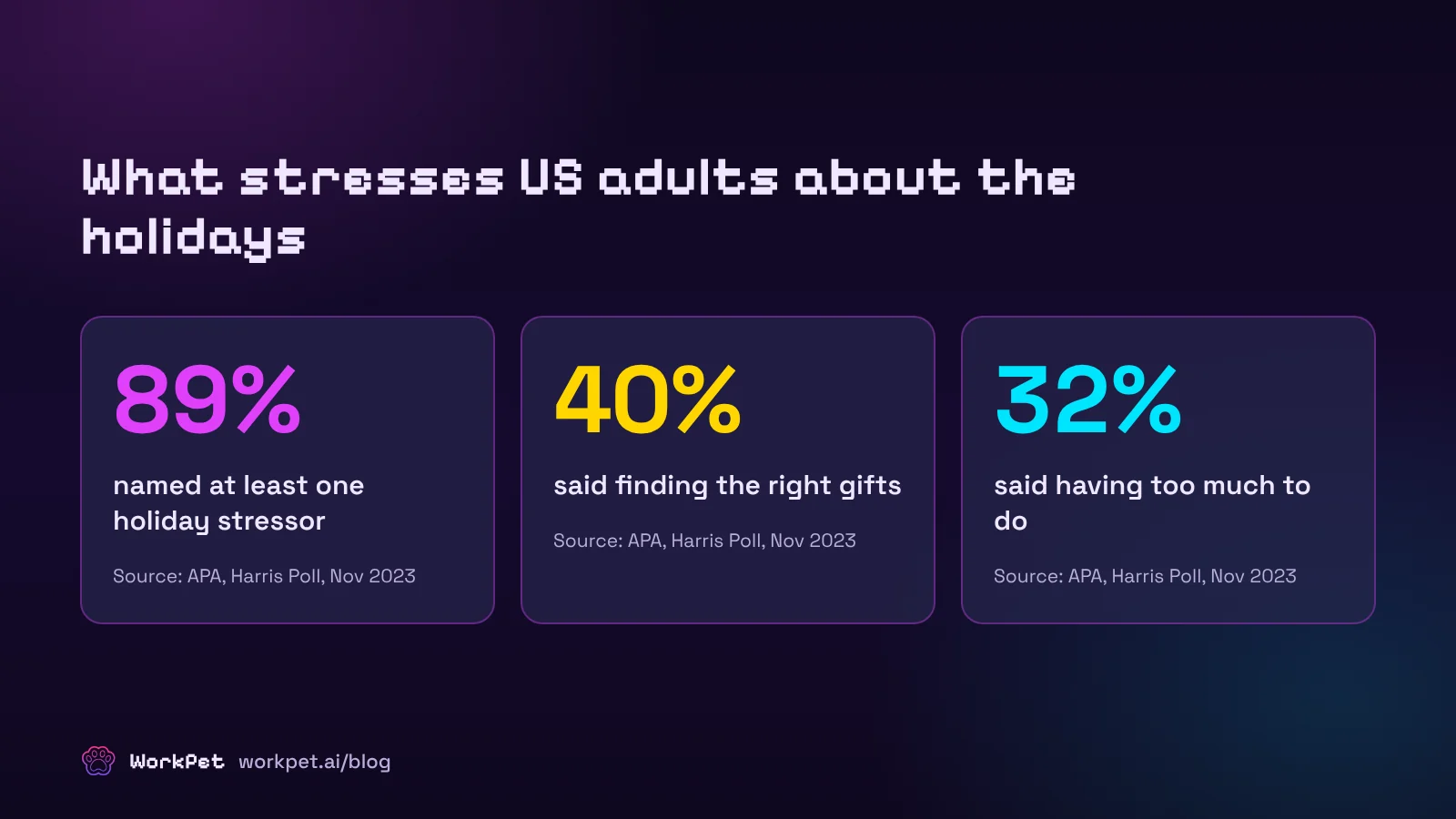
In November 2023, The Harris Poll surveyed 2,061 US adults for the American Psychological Association about holiday stress. 89% picked at least one thing that typically stresses them out during the season. 40% said finding the right gifts, and 32% said having too much to do. 41% said their stress generally goes up during the holidays.
None of those are really one task. "Gifts" is a dozen people, a budget, a few stores, and a wrapping session. "Too much to do" is the whole season sitting in your head at the same time. A list helps most when it breaks those piles into things you can do on a Tuesday.
Get the whole season out of your head first
Grab one piece of paper, or one note on your phone. Not three. Write down everything the next eight weeks might ask of you. Cards, the Thanksgiving dish you said you'd bring, travel, time off work, the cousin whose gift has to ship across the country, the cookie swap at the office.
Don't sort while you write. That's a separate step.
When the page stops growing, go back through it and mark each item one of three ways. It matters to you, it's nice if it happens, or it can go. CHADD's advice on holiday stress puts it plainly. Make what's important for you and your family the priority, and let other things wait until next year. It also suggests asking for help with the planning and wrapping, or paying for help where you can, like having the dinner catered.
If the cards land in "can go" this year, that's a real answer. New Year cards in January are still cards.
Turn "gifts" into a plan you can follow
Gifts were the most common single worry in the APA survey after money, so they get their own list.
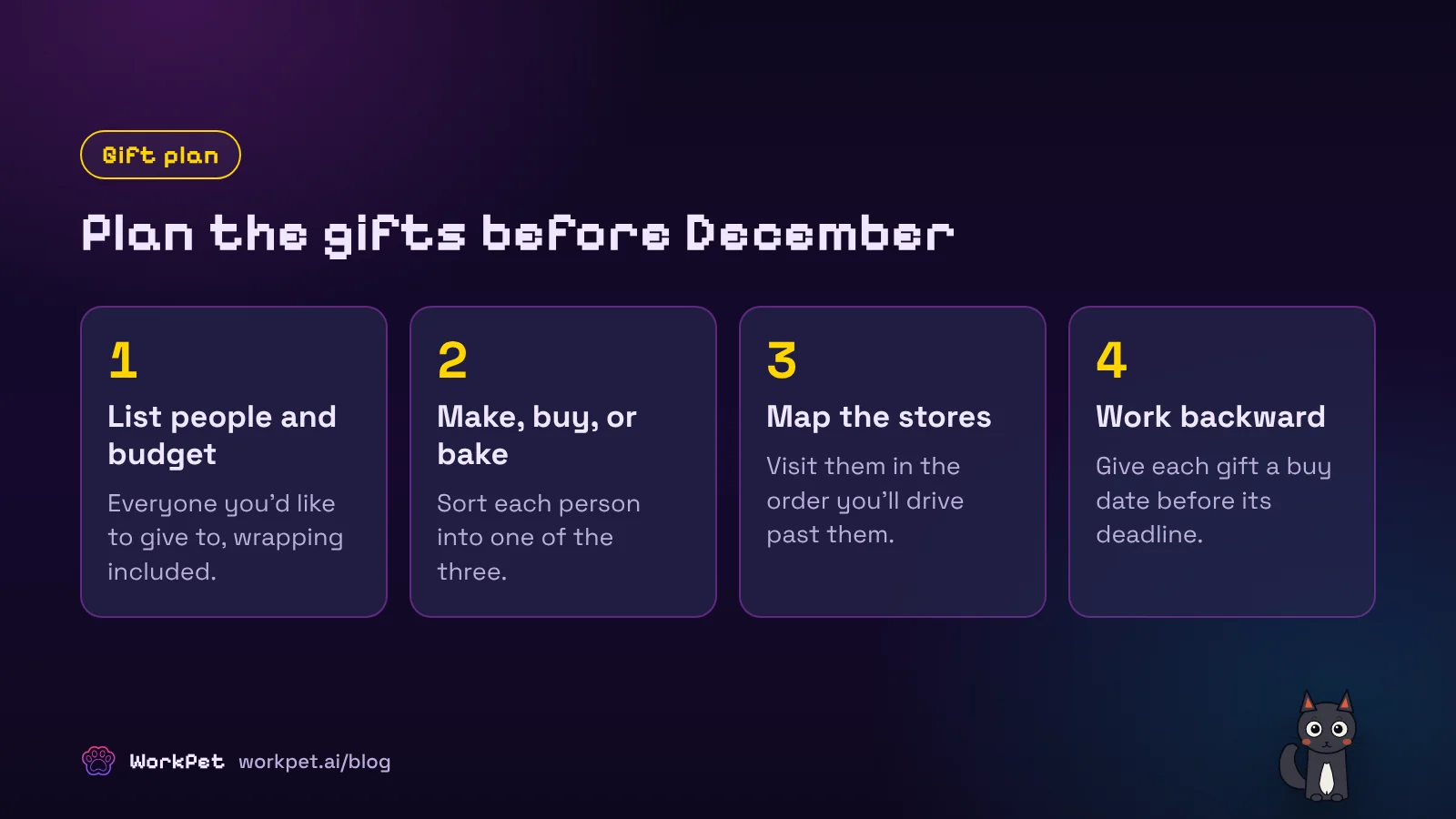
CHADD's guide to holiday gift lists, built on advice from psychologist Sharon Saline, starts with writing down everyone you'd like to give to and how much you can spend, wrapping supplies included. Then it sorts each person into make, buy, or bake. That little grid becomes your shopping plan.
Two more ideas from the same guide help on the days your energy is low. Write down the stores you'll visit in the order you'll drive past them, so one trip covers several people. And bring a friend if you tend to buy things you didn't plan to, since they can tell you when the third scarf is one too many.
Give every task a date, then move it earlier
A list without dates is a wish list. So take each item that made the cut and give it a day.
CHADD's gift guide suggests working backward from the end goal. If the package to your cousin has to arrive by December 20, it has to ship a week or so before that, which means buying it before that, which means deciding what it is before that. Four small tasks, each with its own day, beat one big "send gift" that waits until it's too late.
Then add padding, because most of us guess short. In a 1994 study in the Journal of Personality and Social Psychology, Roger Buehler, Dale Griffin, and Michael Ross asked psychology students in an honors thesis course when they'd finish. On average they predicted 33.9 days. They took 55.5. Even their "if everything goes as poorly as it possibly could" guess, 48.6 days, came in short of what happened. Fewer than a third finished by their own best estimate.
The holidays have a hard edge that a thesis doesn't. December 25 isn't moving. So whatever date you'd normally pick, move it a week earlier and see how that feels.
Keep the list where you'll trip over it
The list does nothing if it lives in a drawer. Tape it to the fridge, set it as your lock screen, or put each dated task straight into whatever reminds you of things. If you keep a tab open as a reminder, that works too, as long as you see it every day.
Small daily pieces tend to go better than one heroic Saturday. Address five cards on Monday. Order one gift on Tuesday. Pick the Thanksgiving dish on Wednesday and buy the ingredients Friday. Each one is small enough to do before you talk yourself out of it.
When the list falls behind anyway
It probably will, at least a little. CHADD's holiday advice starts with expecting that not everything will go as planned, and that it'll be okay anyway. Aim for good enough.
So when a date slips, don't rewrite the whole list. Move the one task, shrink it if you can, or move it to "can go." A gift card sent the day before is still a gift. A text that says "thinking of you" is still a card, sort of.
In WorkPet, you can set each dated holiday task as its own to-do, and every one you finish feeds your pet, even "find the tape."
WorkPet is a productivity tool. It isn't a medical device or a substitute for treatment. If ADHD is making daily life hard, a doctor or licensed clinician is the right person to talk to.
Sources
- 2023 Holiday Stress Survey Data Topline, American Psychological Association
- The Gift of a Holiday Gift List, CHADD
- Get Ahead of Holiday Stress and Enjoy the Season, CHADD
- Exploring the Planning Fallacy, Why People Underestimate Their Task Completion Times (Buehler, Griffin and Ross, 1994), Journal of Personality and Social Psychology, via University of Florida
Sources checked .