A December plan for the end-of-year work pile
How to sort the end-of-year work pile when you work from home, pick a real last day, and leave December with room for the holidays.

Say it's the Monday after Thanksgiving. You open the laptop at the kitchen table, and every "let's circle back after the holidays" from the past three months has circled back at once. The budget review. The handoff doc you promised in August. A slide deck someone needs "before everyone's out." Nobody walks past your desk to see the pile, so it just sits in your inbox and grows.
Working from home makes December strange. There's no office emptying out to tell you the year is winding down, and no commute home to mark where work stops. So the pile tends to spread into evenings and weekends until the break shows up already half used. A plan made now, in mid-November, gives you a few weeks of runway instead of a few days.
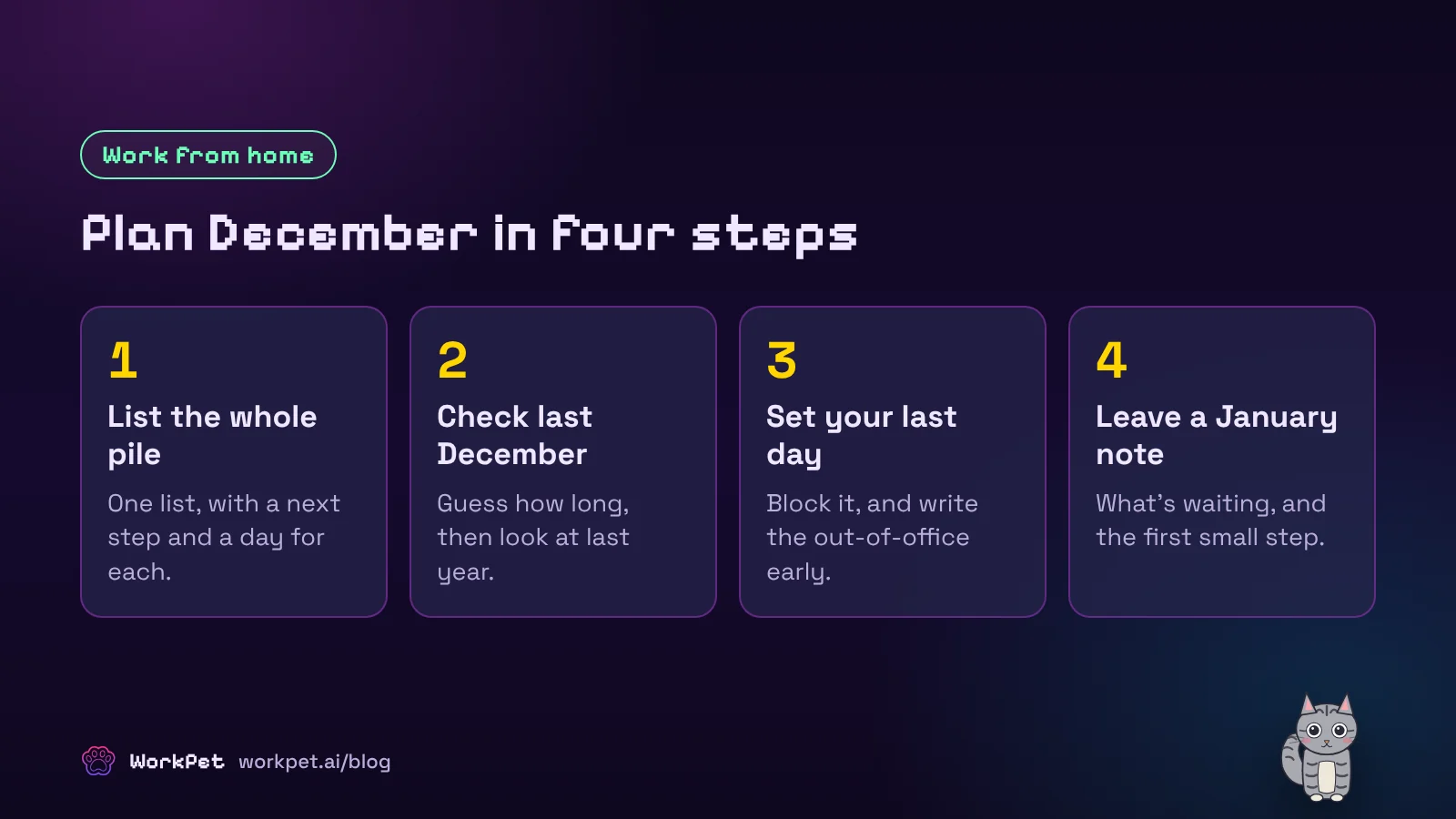
Write the whole pile down, with a next step for each
Start by getting every end-of-year item out of your head and onto one list. Emails, chat threads, sticky notes, and that thing your manager mentioned on a call all go in the same place.
Then give each item one next step and a day. "Q4 report" becomes "pull the October numbers on Tuesday." It can help in a second way, too. In a 2011 paper in the Journal of Personality and Social Psychology, E.J. Masicampo and Roy Baumeister found that making a specific plan for an unfinished goal can remove the way it keeps pulling at your thoughts. Unfinished tasks tend to nag. A plan with a when can let them go quiet until it's their turn.
If you've ever cleaned the whole kitchen to avoid one email, this step is for you. The email gets a day, and the kitchen gets to stay messy.
Guess how long it'll take, then check last December
People tend to be too hopeful about how long their own work will take. In a 1994 study in the Journal of Personality and Social Psychology, Roger Buehler, Dale Griffin, and Michael Ross asked honors students when they'd finish their theses. On average they predicted 33.9 days. It took them 55.5. Only 29.7% finished by the time they'd guessed.
The same paper has a fix worth borrowing. In a later study, the overly hopeful guesses went away when people were asked to connect the prediction to how similar tasks had gone for them before.
So before you promise anything, look back. Search your sent mail from last December. How long did the year-end report take? Did the handoff doc slip into January? If last year's version took two weeks, this year's probably isn't a three-day job, even if it looks like one on Tuesday morning.
Sort it into before the break, January, or not at all
Now go down the list with your calendar open. Some items have a real deadline before the holidays. Some only feel urgent because it's December. And a few were never yours, or have quietly stopped mattering.
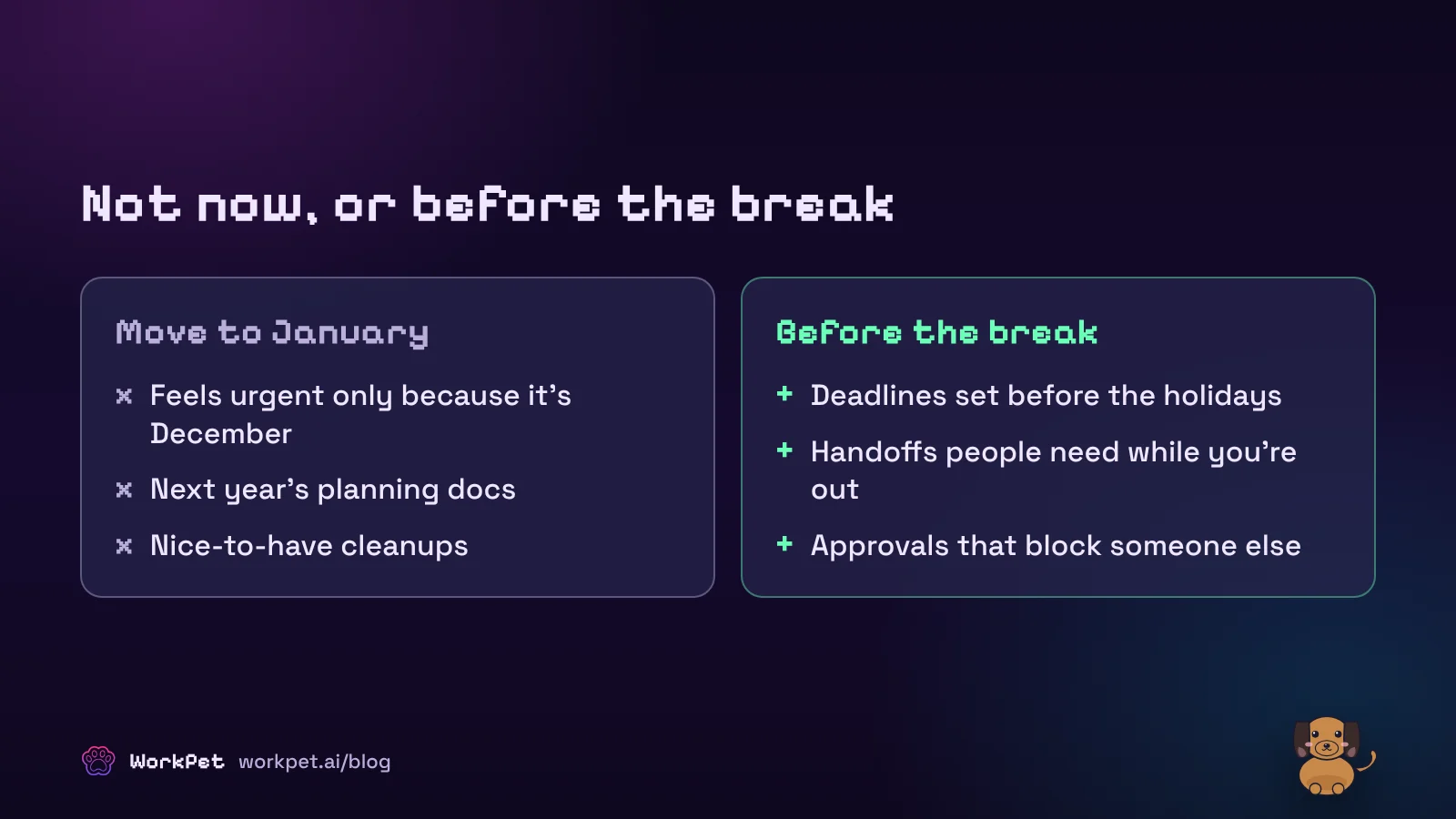
For anything you're moving to January, tell the person who's waiting. "I'll have this to you the week of January 4" is a calmer message than silence followed by a frantic one on the 22nd. Christmas falls on a Friday this year in the US, so the week before it will be shorter than it looks for a lot of people.
Three or four real deadlines before the break is a plan. Twelve is a wish list. If the "before" column is still long, that's the conversation to have with your manager now, not on December 18.
Pick your last day and put it on the calendar
In an office, the building tells you when it's over. At home you have to decide. Choose your last working day, block it on your calendar, and write the out-of-office message ahead of time so it's ready to turn on.
Then work backward. Put each "before the break" item on a specific day, and leave the last day almost empty. It'll fill up with small stuff anyway.
The break is worth guarding. A January 2019 article in the American Psychological Association's Monitor on Psychology describes a 2009 meta-analysis by Sabine Sonnentag and colleagues, which found that vacations have small positive effects on health and well-being, including less exhaustion. The same article notes that those gains faded within a few weeks of getting back. It also describes Sonnentag's 2012 review, which found that people who mentally detach from work in their off-hours report higher life satisfaction.
For remote workers, detaching can be literal. Close the laptop and put it in a drawer. Mute the work chat on your phone for the days you're off. If the kitchen table is also your desk, clear the work stuff off it so dinner isn't eaten next to the budget review.
Leave a note for January you
On your last day, before you close the laptop, write a short note for the first morning back. What's waiting, who's waiting on it, and the first small step for each. Keep it to three or four lines.
This is the same move as the first section. The unfinished stuff has a plan, so it can stop following you around over the break. And when you sit down in January, you won't spend the first hour reading your own inbox to figure out what you were doing.
In WorkPet, each next step can be its own task with a date, and finishing one earns food and coins for your pet, so even "send one email" counts on a slow December afternoon.
Sources
- Exploring the planning fallacy (Buehler, Griffin and Ross, 1994), Journal of Personality and Social Psychology, via the University of Florida
- Consider It Done! Plan making can eliminate the cognitive effects of unfulfilled goals (Masicampo and Baumeister, 2011), Wake Forest University
- Give me a break (Monitor on Psychology, January 2019), American Psychological Association
Sources checked .