A Thanksgiving break study plan that still leaves you a break
How to plan an hour a day of finals studying over Thanksgiving break, using self-testing and spaced sessions, with the rest of the day left free.
Say it's the Tuesday before Thanksgiving. You pack three textbooks, a laptop, and a stack of notes you fully mean to read on the drive home. By Sunday night the backpack is still by the door, still zipped, and finals start in a week and a half.
If that sounds familiar, the break usually isn't the problem. "Study over break" is a hope, and hopes don't come with a time slot. Thanksgiving in the US is Thursday, November 26 this year, so there's still time to make a plan that fits around pie, travel, and the cousin who wants to show you every video on his phone.
Decide what the break is for before you leave
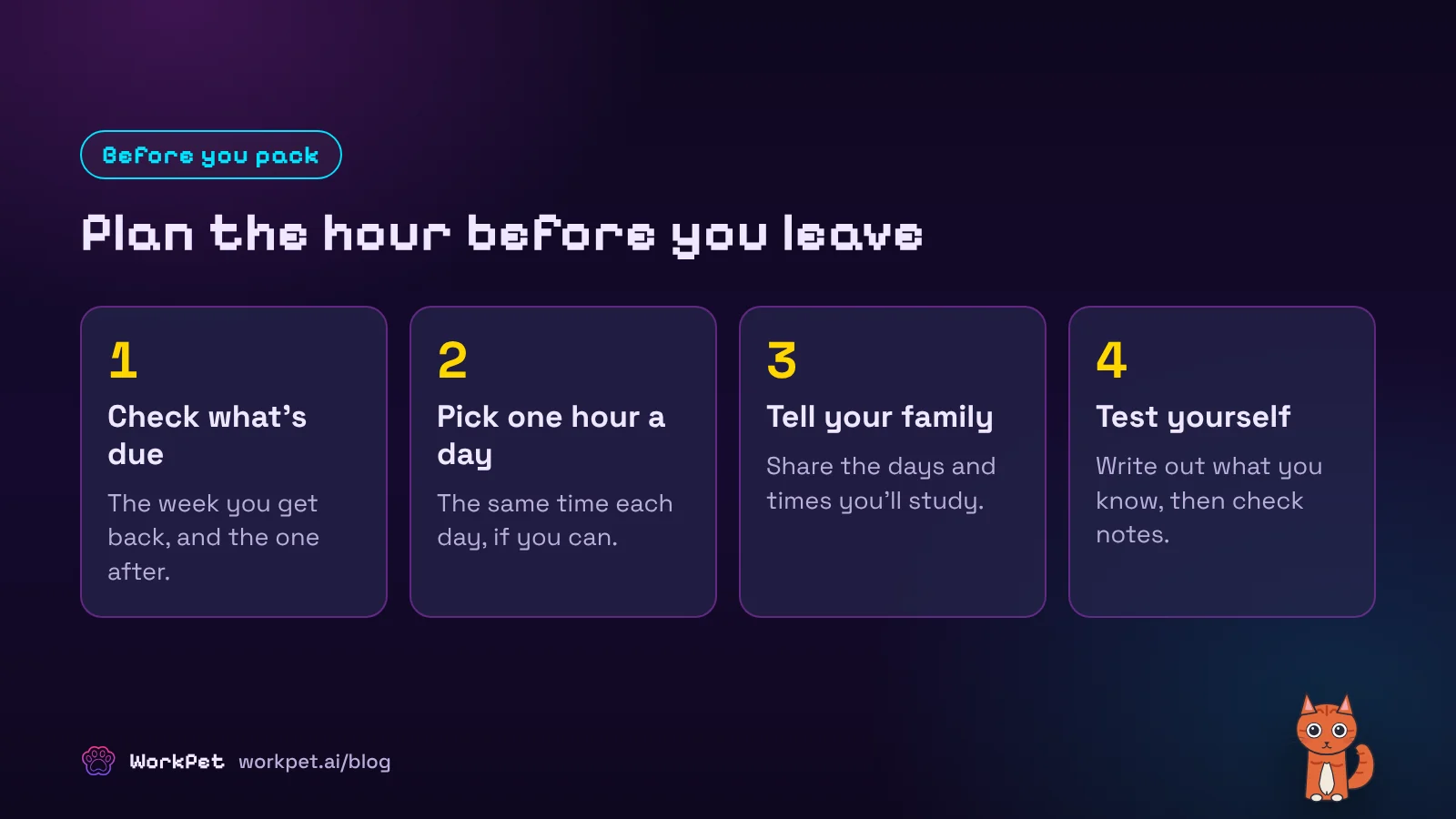
Start with the calendar. Look at what's due the week you get back, and the week after that. Washington State University's Academic Success and Career Center suggests exactly this, then setting realistic goals for the time off, even if that's an hour of finals studying a day.
An hour a day sounds small. Four days off with one hour each is still four hours more than the zipped backpack gives you, and it leaves the rest of the day for the reason you went home.
Pick which hour, too. A student advising leader at the University of Illinois School of Chemical Sciences suggested working in the mornings, so afternoons and evenings stay open for family and friends. The same post suggested getting started the weekend before Thanksgiving, which takes some pressure off the days you're actually away. If mornings are when your house is loudest, choose another slot. Any time works, as long as it's the same one each day.
Tell the people you're staying with
This step feels awkward and saves the most trouble. The WSU center recommends telling family and friends that you have a study schedule, and giving them the days and times, so nobody plans the trip to the outlet mall right on top of it.
You don't need a speech. "I'm studying from nine to ten every morning, then I'm all yours" is plenty. It's easier for everyone to leave you alone for an hour when they know the rest of the day is theirs. And if you're usually the one who gets handed the potato peeler, now everyone knows when you're free to take it.
Use the hour for practice tests, not rereading
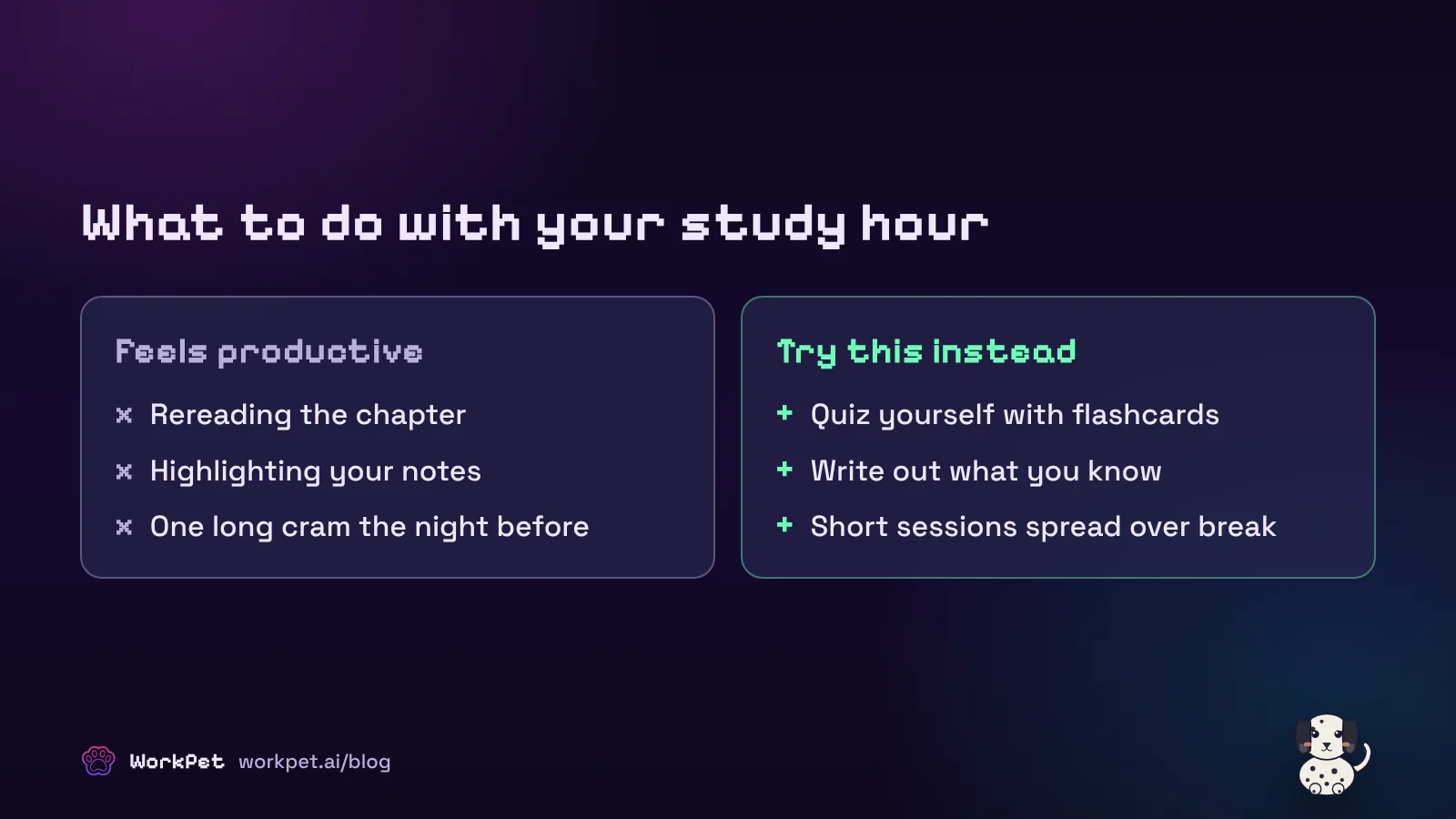
What you do in that hour counts for more than how long it is. In 2013, John Dunlosky and four other researchers reviewed 10 common study techniques for the journal Psychological Science in the Public Interest. Two got their top rating, "high utility." One was practice testing, which means quizzing yourself. The other was distributed practice, which means spreading study sessions out over time.
Rereading and highlighting landed in the low-utility group, even though the review notes that most students report using them. They feel productive, because you're looking at the right pages. But the review found they don't consistently improve how students do.
Self-testing at home can be simple. A 2018 paper by Yana Weinstein, Christopher Madan, and Megan Sumeracki, called "Teaching the science of learning," describes one version. Put your class materials away and try to write out everything you know about a topic. Then open your notes and see what you missed. Flashcards work too. So do old quizzes, or the practice problems at the end of a chapter you skipped.
Spread it out so finals week isn't one long cram
Studying over break is spacing, almost by accident. The 2018 paper describes the spacing effect as the same amount of studying of the same information, spread out over time. It also says spacing can be especially strong when you combine it with retrieval practice, which is the self-testing from the last section. The paper also notes that students tend to cram for exams instead.
So if you quiz yourself on chemistry Wednesday morning and again Saturday morning, that's two spaced sessions before you're even back on campus. Compare that with five hours the night before the exam. Same topic, less sleep, and the research above favors the spread-out version.
One warning from the same paper. Spaced studying is harder, and students may feel less confident while doing it. If Saturday's session feels rougher than cramming would, that's expected. It's what the effort feels like, not a sign the plan is failing.
Keep a short checklist, then let the break be a break
The Illinois post recommended a checklist you tick off each day. Keep it short. Three items for a study morning is a plan. Ten is a wish list. Try something like "redo problem set 4 without the answers," "write out everything from chapter 9," and "make 20 flashcards for the bio final." Each one has an obvious finish line.
Then stop. The WSU post ends on rest, since the break is there to give you some real downtime. If you miss a morning because your aunt's flight got delayed and you spent four hours at the airport, move that hour to the next day. One missed session doesn't cancel the other three.
When you head back to campus, the checklist comes with you. Whatever didn't get done becomes the first thing on Monday's list, already broken into pieces.
In WorkPet, each study block can be its own task, and checking one off earns food and coins for your pet, so the hour at your aunt's kitchen table counts.
Sources
- Teaching the science of learning (Weinstein, Madan and Sumeracki, 2018), Cognitive Research: Principles and Implications, via PubMed Central
- Improving Students' Learning With Effective Learning Techniques (Dunlosky et al., 2013), Psychological Science in the Public Interest, via Duke University Scholars
- How to not let Thanksgiving Break derail your semester, Washington State University Academic Success and Career Center
- How to manage school work over Thanksgiving break, University of Illinois School of Chemical Sciences
Sources checked .